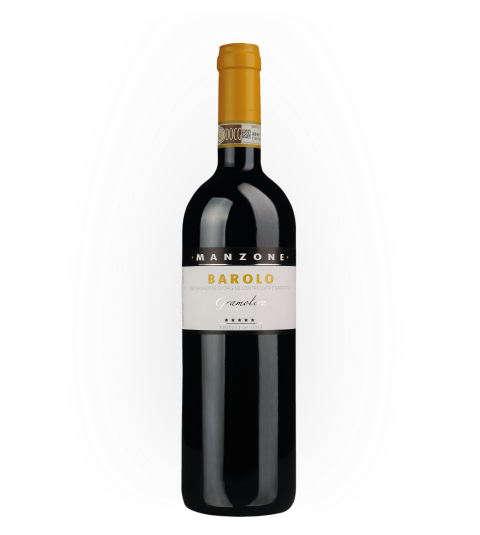
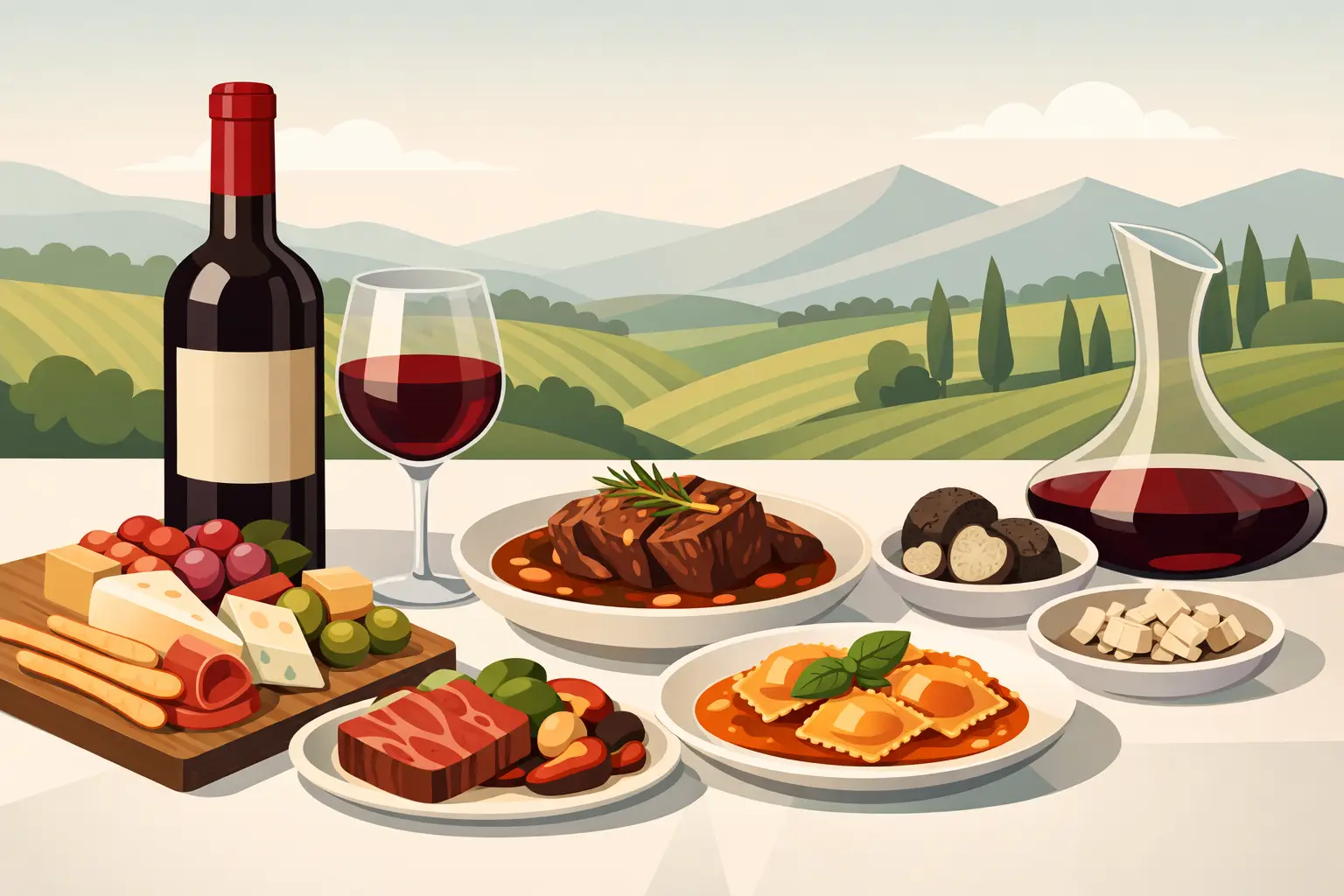
Barolo does not ask for complicated food. It asks for food with depth. The best food pairings for Barolo respect its defining character: perfume, firm tannin, bright acidity and the savoury, earthy detail that Nebbiolo draws from the Langhe hills. A great bottle can be delicate in aroma yet commanding on the palate, so the dish must meet it with substance rather than noise.
This is why Barolo belongs so naturally at a long table in Piedmont. Its finest companions are not chosen for novelty. They are chosen for texture, patience and a shared sense of place: slow-cooked meat, handmade pasta, mushrooms gathered in season, mature cheese and the quiet luxury of white truffle.
Begin with Barolo’s structure
Before choosing a dish, consider the age and style of the wine. Young Barolo often shows a firmer tannic frame, vivid red fruit and floral notes of rose and violet. It benefits from protein, fat and slow-cooked textures that soften its grip and allow its fragrance to emerge.
With bottle age, Barolo becomes more expansive. Cherry and plum give way to dried flowers, tobacco, leather, woodland earth and balsamic notes. The tannins settle into a finer weave. An older bottle can be extraordinary with a simpler dish, provided its ingredients are excellent and its seasoning is restrained.
The vineyard also matters. Barolo is never one single expression. A wine from a site with a more structured, mineral character may call for braised beef or game. A more open, perfumed expression can be beautiful with tajarin, porcini or a carefully made mushroom risotto. The principle is not to make rigid rules, but to match weight, texture and intensity.
The classic food pairings for Barolo
Brasato al Barolo and other slow-cooked beef
Brasato is the reference point for good reason. Beef slowly braised until tender has the depth to stand beside Barolo, while its gelatinous texture cushions the wine’s tannin. The wine’s acidity keeps the dish from becoming heavy and refreshes the palate between mouthfuls.
The sauce should be concentrated but not sweet. Too much tomato, sugar or reduction can make Barolo seem austere. Aromatic vegetables, stock, herbs and a measured use of wine create a better bridge. Serve with polenta, potato purée or soft, buttery vegetables rather than aggressively spiced sides.
Other cuts cooked with patience work equally well: beef cheek, ox tail, short rib or a well-marbled roast. For a younger Barolo, this is often the most assured place to begin.
Tajarin, butter and white truffle
In the Langhe, few combinations feel more inevitable than fine egg pasta dressed with butter and white truffle. The dish is spare, but not slight. The richness of yolk and butter gives Barolo a soft landing, while truffle echoes the wine’s own earthy, undergrowth notes without obscuring its perfume.
The timing is crucial. This pairing is at its most eloquent with a Barolo that has begun to relax, when the tannins are polished and tertiary complexity is emerging. A very young, tightly structured wine can overwhelm the delicacy of truffle. If the Barolo is youthful, choose a fuller pasta dish with mushrooms, a light meat ragù or braised veal instead.
White truffle needs restraint. Avoid garlic, chilli and excessive cheese. They flatten the fragrance that makes both the dish and the wine so memorable.
Porcini, wild mushrooms and risotto
Mushrooms are among the most reliable answers to the question of what to serve with Barolo. Their savoury, woodland character complements Nebbiolo’s tar, rose and earth notes, while their umami gives the palate a satisfying sense of completeness.
A porcini risotto works especially well with a Barolo of some maturity. Keep the stock refined and the texture loose, with enough butter and Parmigiano Reggiano to lend richness but not so much that the wine tastes severe. Grilled mushrooms on toast, mushroom ravioli and roasted ceps with thyme can also be excellent, particularly for lunch or an early autumn supper.
For the most structured wines, add a deeper element: a little veal jus, roasted guinea fowl or a ragù of wild mushrooms and beef. Barolo appreciates food that has been properly made.
Game birds, venison and hare
Barolo has a natural affinity with game, especially when the season brings cooler air and longer cooking. Pheasant, partridge, pigeon and guinea fowl offer enough flavour for the wine without the overt richness of some red meats. Roast them with herbs, mushrooms and a proper jus, and avoid fruit-heavy sauces that can pull the pairing out of balance.
Venison is particularly compelling with mature Barolo. Its leanness and mineral flavour allow the wine’s acidity and savoury complexity to show clearly. Choose a loin or haunch cooked pink, then accompany it with celeriac, juniper used sparingly, beetroot or a dark mushroom sauce.
Hare, when prepared in the traditional slow-cooked style, is a more serious proposition for an evolved Barolo. Here, the wine’s evolved notes of leather, dried leaves and spice find an equal partner. It is a pairing for a winter table and a bottle worth opening with attention.
Pair Barolo with pork and veal when finesse matters
Barolo does not require red meat at every turn. Veal is one of its most graceful companions, especially in Piedmontese preparations. A veal chop, roasted until just tender and served with porcini or a reduced jus, has sufficient substance for the wine while preserving elegance.
Pork can work beautifully too, particularly shoulder, belly or a slow-roasted collar. The fat is useful with young Barolo, yet the seasoning must remain measured. Fennel, sage, rosemary and chestnuts are more sympathetic than sticky glazes or pronounced sweetness.
This is where a perfumed, less overtly powerful Barolo can shine. The pairing becomes less about matching force and more about creating a conversation between floral aromas, roast flavours and supple texture.
Cheese: choose maturity, not aggression
Aged cheese is a natural late-course partner, but the strongest blue cheeses are rarely ideal. Their salt and pungency can make Barolo’s tannins feel harder and diminish its fragrance. Better choices have nutty depth, savoury length and a firm but yielding texture.
A well-aged Parmigiano Reggiano is a classic, particularly with an older bottle. Castelmagno, a treasured Piedmontese cheese, can be excellent when it is not excessively blue or sharp. Pecorino with a little age, or a mellow hard Alpine cheese, can also work.
Serve cheese at room temperature and keep the accompaniments simple. Walnuts, a little honey or pear may suit the plate, but use them lightly. Barolo is not improved by a crowded cheeseboard.
What to avoid with Barolo
The difficult pairings reveal as much as the successful ones. Delicate white fish, sharp vinegar-led dishes and very spicy food tend to leave Barolo tasting angular. Sweet sauces can make its tannins seem dry, while heavily smoked flavours may conceal the wine’s finer aromatics.
Tomato is not impossible, but it needs care. A slow-cooked meat ragù with tomato in the background can work. A bright, acidic tomato sauce generally asks for a different red. Likewise, a highly creamy dish without mushroom, meat or umami depth can make Barolo appear stern rather than generous.
Temperature deserves attention too. Barolo should not be served warm. Around 16-18°C is usually a sound range, allowing perfume to rise while retaining freshness. Decanting a young bottle can be useful, but give an older bottle gentler handling and let the glass reveal its pace.
A Barolo table is built around patience
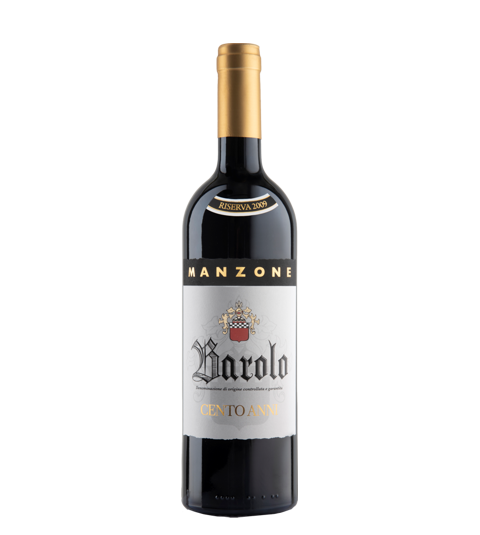
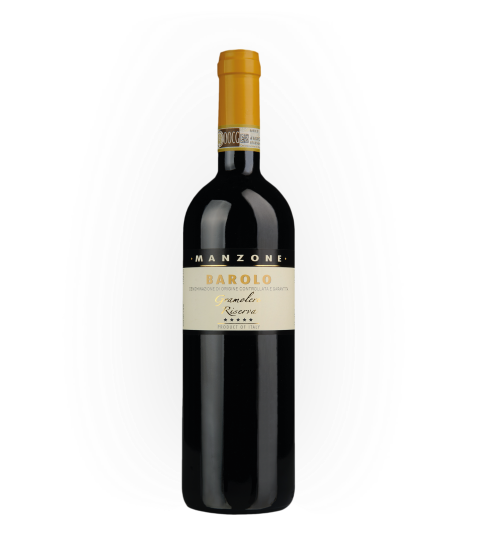
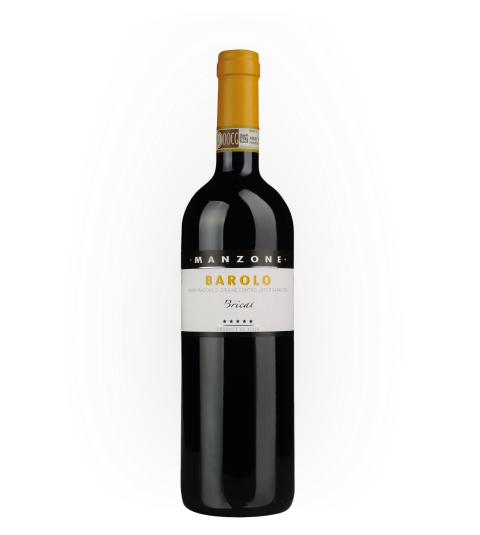
The finest pairing may be less about a single ingredient than the manner of the meal. Barolo rewards time: time in the vineyard, time in the cellar, time in bottle and time at table. At Manzone Giovanni, the family approach to Barolo begins with respect for the individual character of each hillside and continues with restraint in the cellar. Food should meet that same standard of clarity.
Choose one well-made dish. Let the ingredients speak plainly. Open the bottle early enough for it to settle into the evening, and allow each course to follow the wine rather than compete with it. That is where Barolo is most at home: not as an ornament to dinner, but as part of a table with a sense of place.